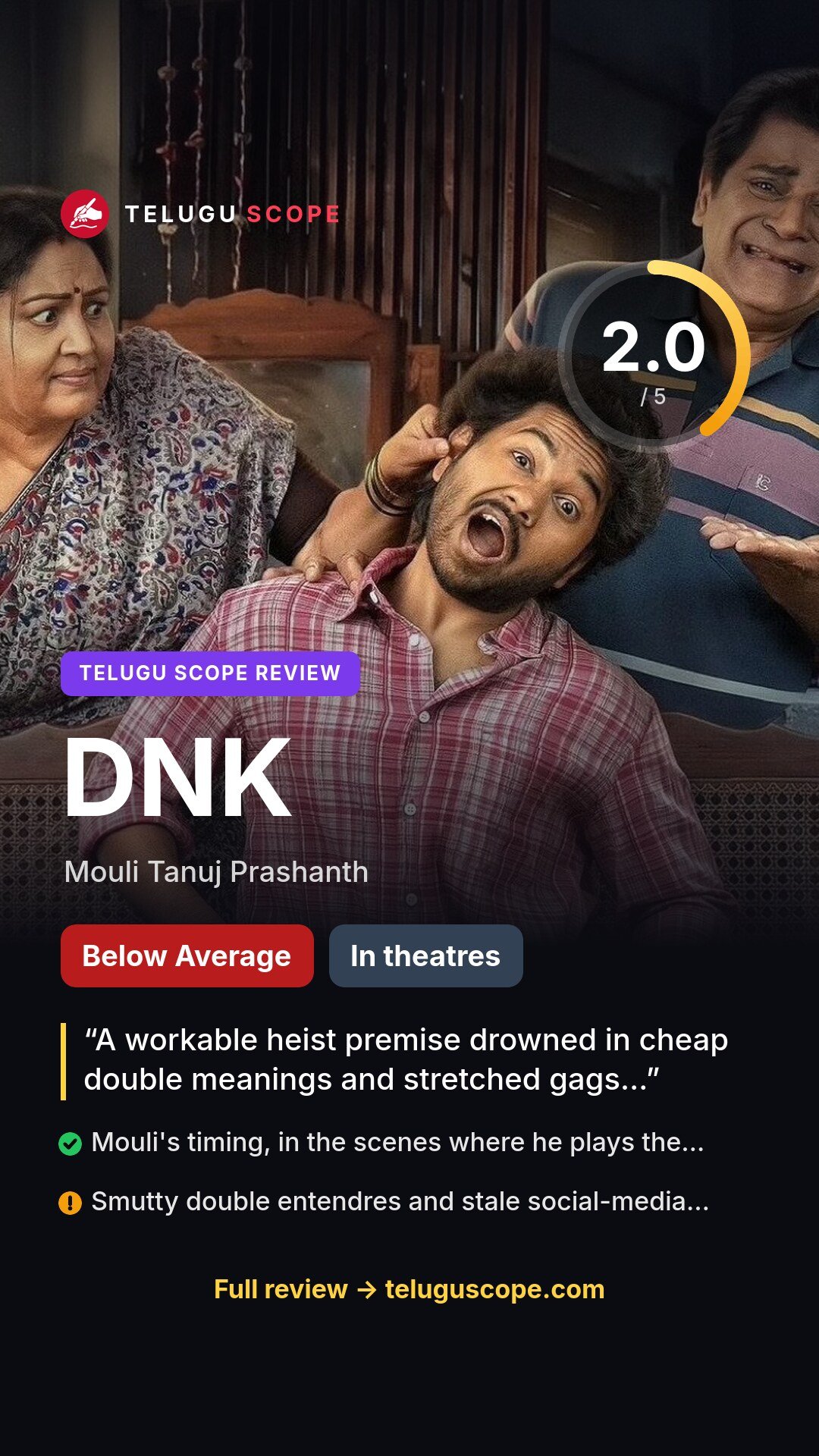
Original bilingual journalism · English & తెలుగు

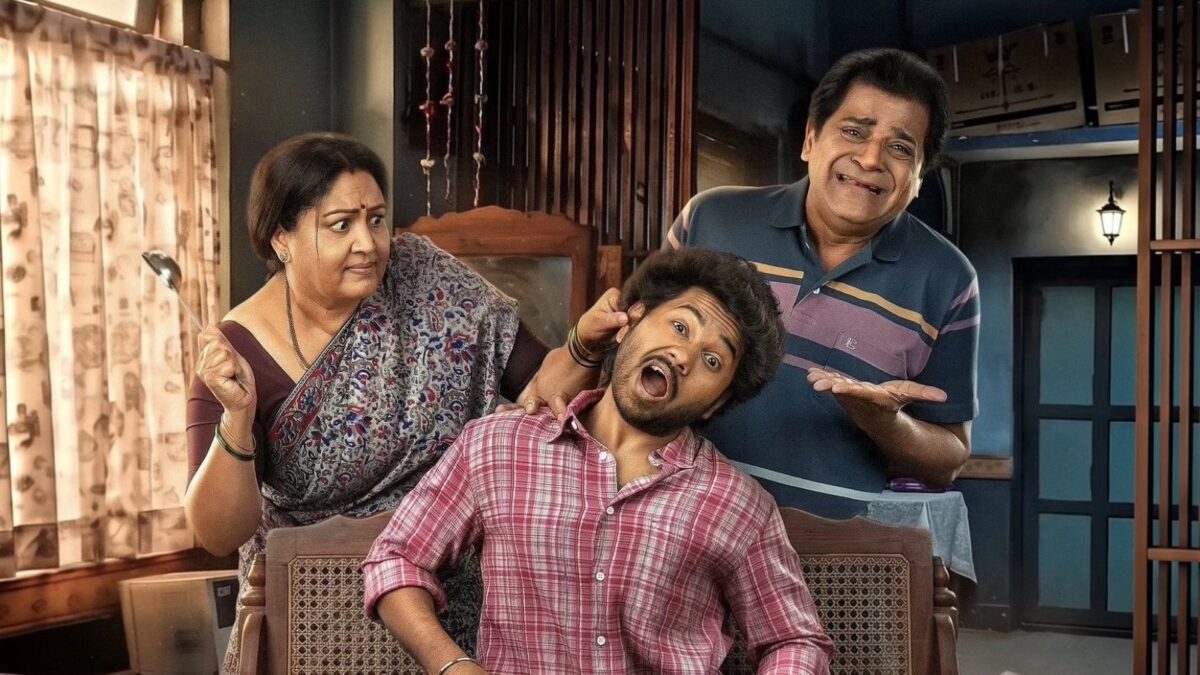
DNK opened in theatres on 13 November. Announced as Donga Naa Koduku, it reaches screens under its initials after the censor board objected to the full title. It is the second film for Mouli Tanuj Prashanth, the YouTuber who became a leading man with the 2025 surprise success Little Hearts, and the first for Sreenu Kambala, who wrote and directed it. Naveen Yerneni and Y. Ravi Shankar are the producers, under the Mythri banner. Sushmitha Shetty, Ali, Rajitha and Raghu Babu make up the main cast, and Sinjith Yerramilli, the composer of Little Hearts, is back on music. The film is certified UA 16+ and runs 2 hours 11 minutes. Our verdict: a crime comedy with a usable premise and a few honest laughs, smothered by coarse humour, stretched scenes and a thin screenplay. Mouli’s timing still works in flashes; the film built around him seldom does.
Story and screenplay
Mouli plays Eeshwar, a Visakhapatnam layabout who walked out of his engineering course and now chases quick money on cricket bets and gaming apps. The losses only mount. He borrows from loan apps, pilfers at home and even pawns gold rings belonging to his girlfriend, Deepu (Sushmitha Shetty), until her parents land at his door and shame him before the whole neighbourhood. Cornered, Eeshwar and his friend (Babloo) conclude that a single big job can wipe the slate clean: a raid on a jewellery shop. How that scheme pulls his family into trouble is where the film takes over, and the many turns that follow are better left unspoilt.
On paper this is sound material for a genre Telugu audiences have long enjoyed, and there are smiles early on, in the romance with Deepu and in the loan-app trouble that follows Eeshwar home and drags in his parents. The bigger problem is the humour, and the screenplay around it. Small gags are stretched well past the point where the laugh arrives. Much of the dialogue is smutty double entendre or stale social-media memes, with the odd spoof of an older hit thrown in, such as Ali’s one-scene take on Balakrishna’s famous lines. A thread that turns a gay character into the punchline feels plainly dated.
Once the robbery enters the picture, the twists start arriving, and they are hit and miss. Several land, while others pile up until they tire rather than surprise, and the last of them carries little force. A gag planted in the hero’s very first scene does get its payoff near the end.
Direction
From Mouli’s very first scene, Sreenu Kambala dresses him up in mass-hero trappings, all slow-motion shots and punch lines, and they sit awkwardly on an actor whose appeal lies in seeming like the boy next door. The debutant never decides how much of this is a crime story and how much a comedy, and he lets nearly everyone play at top volume. The scale is small for a Mythri production, with much of the film shot in a limited number of locations, though what is on screen looks tidy enough. Anyone hoping for a tight crime caper will find that side thin, and anyone hoping for clean fun will wince at the humour.
Performances
Mouli still has the knack for timing, and in a handful of scenes, mostly when he plays the hapless slacker rather than the hero, the old ease comes through. What has gone missing is the guileless, everyday quality that made audiences warm to him in Little Hearts, and the heroics and coarse lines the script loads on him are a poor fit. Babloo, as his partner in crime, is the liveliest of the supporting cast and gets a few laughs, though he overdoes it at times. Ali and Rajitha are dependable as the exasperated parents. Sushmitha Shetty’s part gives her almost nothing to do. Raghu Babu and Priya are underused, Gundu Sudarshan does what is asked of him, and Bhadram appears in a comic role. Across the ensemble, the default setting is loud.
Music and craft
None of Sinjith Yerramilli’s songs stays with you, and the story makes little room for them. His background score fares better: it has fresh moments and gives some lift to weaker scenes, though at times it is simply loud. Suriya Balaji’s camerawork is serviceable on a tight budget. Sreedhar Sompally’s cut needed to be much tighter, since comic bits overstay their welcome. The trailer’s closing card carried the Netflix logo; no streaming date has been announced.
Verdict
Somewhere inside DNK is a decent crime caper: a broke young man with no direction, a desperate plan and a family left paying for his mistakes. The film spends that premise on crude jokes, padded scenes and a screenplay that keeps losing its way. Mouli’s timing and Babloo’s energy rescue a few scenes, not the whole. For an actor whose first film won people over by feeling real, this is a detour best put behind him quickly. Unless you are a devoted fan, it can wait for streaming.