Original bilingual journalism · English & తెలుగు

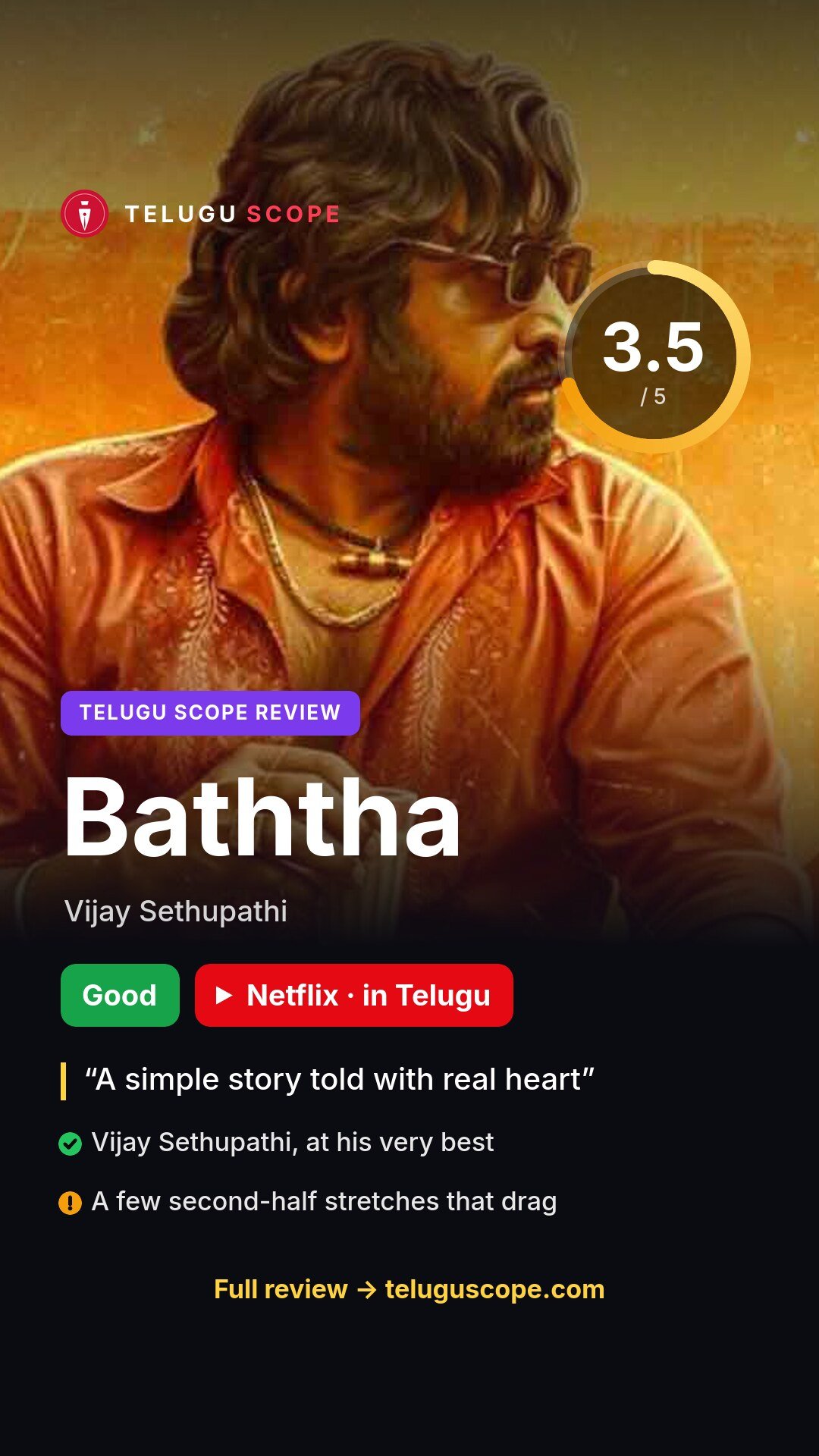
Baththa, the Tamil film that opened in theatres on 1 October, is now streaming on Netflix, where it arrived on 29 October with a Telugu version alongside the original. Balaji Tharaneetharan writes and directs, Atlee presents it, and Vijay Sethupathi takes the title part. The story itself is a simple one. What makes it worth your evening is the way it is told, a child actor who holds his own against a star, and a Sethupathi performance that ranks with the best work he has done. Our verdict: a warm, well-made film that the whole family can sit down to, even if the second half slows in places.
Story and screenplay
The story unfolds in 1980s Madras. Baththa is a gangster the whole neighbourhood fears, and the stories about him grow bigger each time they are told. Sabari, a young schoolboy, has grown up on those stories. While trying to get back a toy that was taken from him, the boy accidentally shuts Baththa in a school toilet and the door stays locked. From that one odd, funny accident the film builds a friendship between a frightened child and a violent man who now has nothing to do but think about the life he has led.
There are no big twists here, and the film does not need them. The screenplay keeps finding small, human moments inside a very small space, and it moves easily between laughter and feeling. The first half is especially tight. After the interval, a few stretches go on longer than they should and the pace dips, but the film always finds its way back before your attention drifts too far.
Direction
Balaji Tharaneetharan trusts his idea. He keeps the camera close to his two leads, lets scenes breathe, and never pushes the sentiment harder than the story can carry. The 1980s Madras setting feels lived in rather than decorated, and the humour comes from the characters, not from set-piece jokes.
Performances
This is Vijay Sethupathi at his very best. He makes Baththa frightening and foolish, proud and lost, often in the same scene, and much of his work is done in silence. Even so, the film belongs just as much to Master Sai Prithviraj as Sabari. His performance is extraordinary for an actor his age: unforced, funny and moving, and the film’s emotional pull rests on him. Lijomol Jose as Baththa’s wife Kannima and the rest of the cast give the two leads solid support.
Music and the Telugu version
Sai Abhyankkar’s background score ranks among the strongest things about the film. It lifts the comedy, sharpens the tension and carries the emotional scenes without drowning them. The Telugu dubbing is very good, too. The voices suit the characters and the dialogue sounds natural, so Telugu viewers lose very little by watching it in their own language.
Verdict
Baththa is a simple story told with real heart. A few slow patches in the second half keep it from being perfect, but outstanding performances, a fine background score and a clean, family-friendly tone make it an easy recommendation. For a family evening, the Telugu version on Netflix is a good pick.