
Original bilingual journalism · English & తెలుగు
Andhra’s local polls turn violent at the nomination desk: what the record says, then and now
Police logged 31 poll-related incidents in 13 districts on 22 October alone. A look at the documented record of 2021 and 2026, and why nomination counters keep becoming the flashpoint.

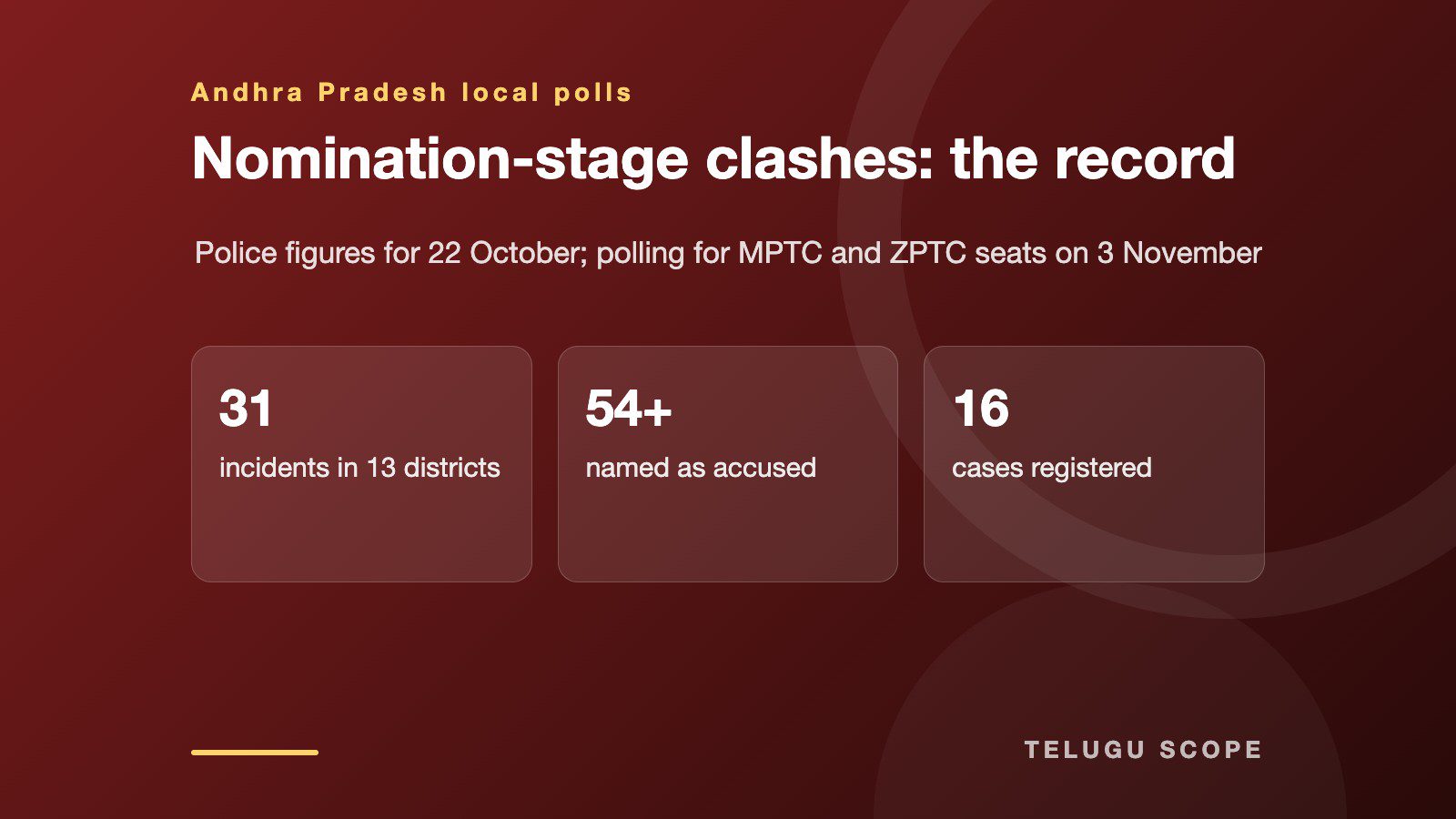
Andhra Pradesh’s local body elections have produced a pattern that is easy to see and harder to explain: the fight is being won or lost at the nomination counter, before a single vote is cast. The Director General of Police’s office said on 22 October that 31 election-related incidents were recorded in 13 districts that day, 22 of them involving violence, clashes or public-order disturbances. Police registered 16 cases, named at least 54 people as accused and said four were caught at the spot.
What the police have documented
The DGP’s statement listed stone-pelting in six incidents, four vehicles set on fire, two houses damaged, one case of firing in the air and a police escort vehicle damaged. Candidates of the TDP, the YSRCP and the CPI(M), and an independent, were among those targeted, the statement said. DGP Harish Kumar Gupta said the destruction of nomination papers was a direct attack on the right to contest and that the law “makes no distinction between political parties”.
State Election Commissioner Anil Chandra Punetha, in a video conference on 21 October, told collectors and superintendents of police to prevent violence during nominations and to give candidates security. Polling for the MPTC and ZPTC seats is on 3 November.
The two sides
The YSRCP, in a statement by its state coordinator Sajjala Ramakrishna Reddy, alleged 76 incidents of attacks, arrests, house confinement, threats and destruction of nomination papers in 11 districts. Former deputy chief minister K Narayana Swamy was among those the party said were attacked in Chittoor district on 21 October.
The TDP rejects that account. Its spokesperson Kommareddy Pattabhi said the YSRCP, aware it lacked public support, was trying to disrupt the process, and the party said violence in Darsi, Punganur, Rayachoti, Kadapa and Pulivendula was caused by YSRCP leaders. Earlier, on 16 October in Punganur, Madanapalle DSP B Prasad said an MP’s convoy of more than 10 vehicles caused a disturbance before nominations began and described the event as not an attack on the MP; the YSRCP says its convoy was attacked. The YSRCP then announced on 18 October that it would stay out of the Punganur municipal polls.
The courts
The Andhra Pradesh High Court refused on 18 October to extend the nomination deadline for the urban bodies. On 21 October the Supreme Court directed the State Election Commission to decide the YSRCP’s plea for an extension where candidates say they were stopped from filing, and to hold back the final candidate list until 25 October.
Was it different in 2020-21?
The earlier term was not free of contested local polls. In 2021, when the YSRCP was in power, the parishad contest drew its own disputes. The YSRCP’s candidates were declared winners unanimously in 2,271 MPTC and 126 ZPTC seats before a vote was cast. In March 2021, then Commissioner Nimmagadda Ramesh Kumar called forced withdrawals of nominations in municipal polls “unforgivable” and told returning officers to examine police complaints; the High Court quashed his orders allowing fresh nominations in 14 wards. On 4 April the TDP leader N Chandrababu Naidu announced a boycott of the parishad polls, saying he did not expect them to be free and fair, though his stated grounds concerned the notification and the new Commissioner rather than street violence. Counting of the 8 April vote was held up in court until a division bench cleared it on 16 September 2021.
Our assessment: 2021 was a contest of numbers and courtrooms, won through unopposed seats, withdrawal disputes, a boycott and months of litigation. 2026 is a contest of the nomination counter itself, where stones, fire and torn papers decide who gets to stand.
Why the counter becomes the battleground
In our view, the facts above point to three reasons. First, these are the first parishad and municipal elections since the change of government in 2024, and the bodies being elected control local funds. Second, an unopposed win is a cheap way to take a seat, so the side that dominates a locality has every reason to stop rivals filing, and the 2,271 unanimous seats of 2021 show how large that margin can be. Finally, the scale is huge, with thousands of seats and counters in every mandal, so police thinly spread are tested everywhere at once.
Whichever party holds power, the record suggests the remedy is procedural: videotaped nominations and withdrawals, enforced police protection and quick registration of cases. The courts and the Commission are now being asked to supply it.
Illustration: Telugu Scope
More Stories
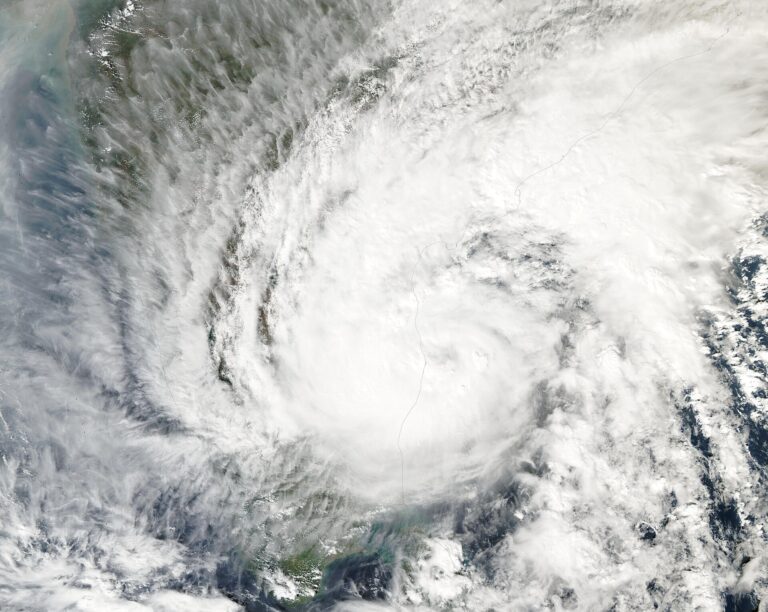 Andhra PradeshBay of Bengal low expected to become a cyclone on 26 October; coastal Andhra braces for heavy rain on 27 and 28 October
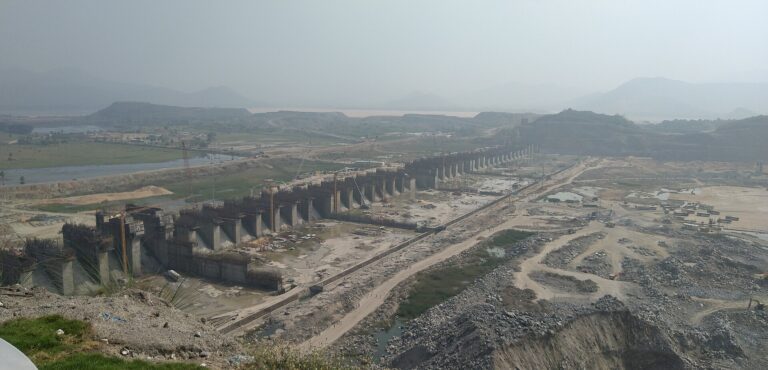 Andhra PradeshNaidu sets December 2028 for 36 irrigation projects and orders Chintalapudi works to restart in November
 Andhra PradeshTirumala’s five reservoirs gain a net 40.08 lakh gallons in TTD’s 23 October reading
 Andhra PradeshKrishna board’s full meeting on 26 October to take up water sharing and Srisailam drawals
 Andhra PradeshAt least four Bhavani devotees die after speeding vehicle hits them near Kathipudi
 Andhra PradeshAP Intermediate public exams 2027 to run from 24 February to 16 March